
Workflow 1
Workflow 1: Integration of existing computational services within the Phytoplankton VRE
Workflow 1 is designed to create an integrated workflow within the Phytoplankton Virtual Research Environment (VRE) that incorporates the existing web services and functionalities in order to simplify and automate their use. The workflow includes six core services:
- Traits Computation: a web service to calculate phytoplankton traits such as density, biovolume, biomass, surface area, surface/volume ratio, cell carbon content, total biovolume, total biomass, total carbon content.
- Size Class Distribution: a web service to visualize the distribution of individuals in different size classes selected on the basis of logarithmic values of biovolume or carbon content.
- Size Density Relationships: a web service to calculate and describe the relationships between size (average biovolume and average cell carbon content) and abundance.
- Data Filtering: a web service to exclude from the data files taxa based on their ranked distribution in density, biovolume or carbon content.
- Community Matrix and Analysis: a web service to create a community matrix from the input data file for each taxonomic, spatial and temporal level selected, based on the trait density, biovolume or carbon content.
- Community Indices: a web service to calculate phytoplankton community indices based on the traits density, biovolume and carbon content using different combinations of spatial and temporal levels.
Moreover, the workflow may also include additional optional services that can be used according to the users’ needs, namely: a Table-joining service, Taxonomic checker service to review the taxonomy of the phytoplankton data, Geographic checker service to visualize the sampling points of the dataset.
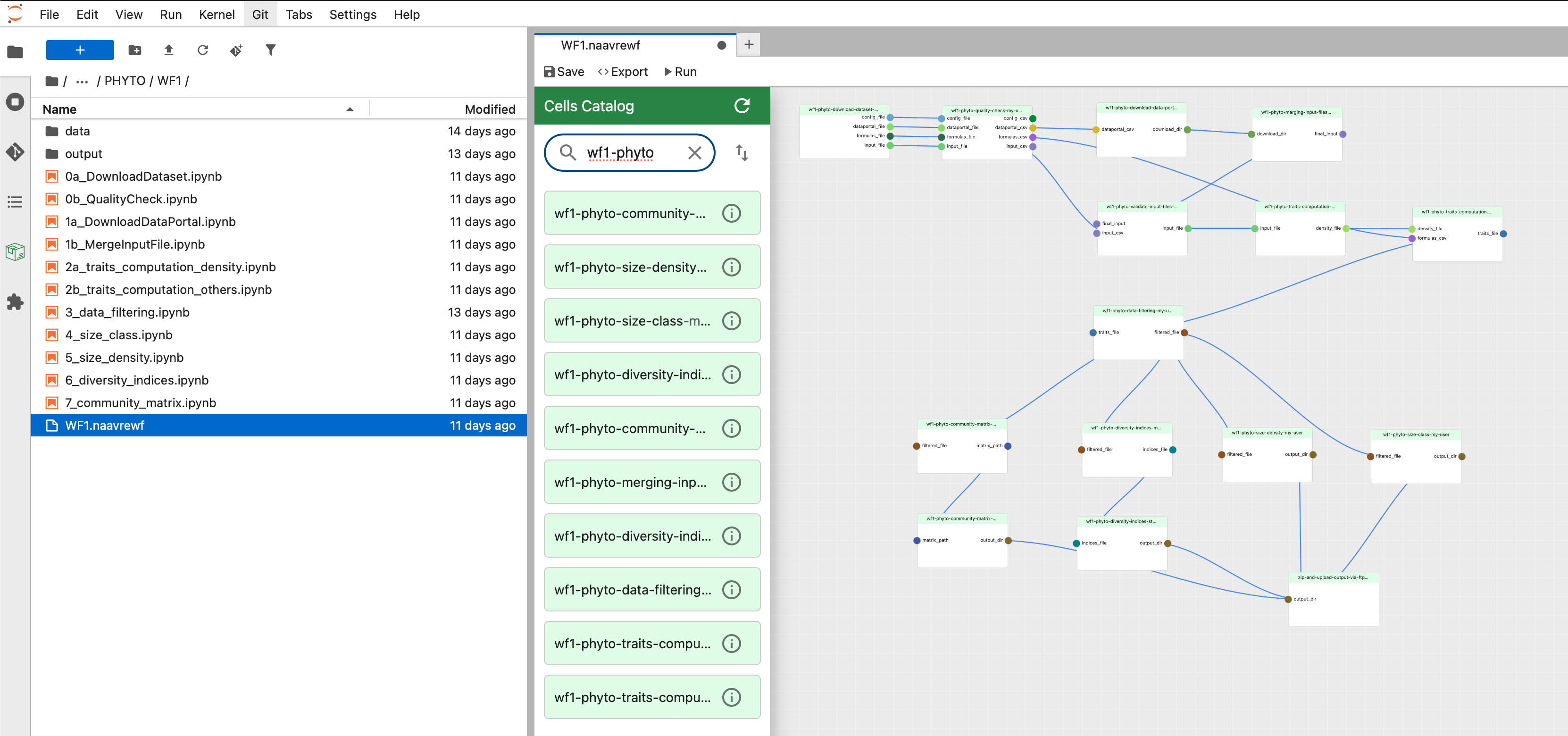
Thanks to its modular structure, this workflow is flexible and easily adaptable. Users can customize the workflow by editing the code and parameters and by adding or removing cells. Furthermore, the workflow can be tailored to specific research needs by performing additional analyses.